The cost of a Windows program is not set by the number of screens alone. Eight factors set it: how many special cases your work has, where the data lives (one PC or shared), permissions, connected devices, printing, reports, links to other systems, and who maintains the program after delivery. The largest cost people overlook is not the build but the changes afterwards. Reducing cost starts with a smaller first version and clearly written requirements before you ask for any quote.
- how much does it cost to build a Windows program
- cost of custom desktop software for a small business
- how much does a developer charge for a POS program
- what affects the price of custom software
- cheapest way to make a computer program
- custom software vs ready-made software cost
Why is there no single price for a Windows program?
Because asking 'what does a Windows program cost?' is like asking what it costs to fit out a shop. The answer depends on size, location and finish. An invoicing tool for a freelancer on one PC is one thing; a stock system for three branches with permissions and reports is something else entirely, though both are 'a Windows program'.
 Illustration
You will find no figures in this article, neither our prices nor anyone else's, because any general number would mislead you about your own case. You will find something more useful: the factors that move the price, so you can read any quote you receive, know where to push to lower it, and know where not to economize.
Remember that cost has three faces, not one: the money you pay, your time explaining, following up and testing, and the waiting time until the program is in your staff's hands. A route that is cheap in money can be the most expensive in the other two.
What actually drives the cost?
Eight factors. Each time one of them moves toward the 'most complex' column, the work grows, whether the builder is a developer or a tool:
| Factor | Simplest | Most complex |
|---|---|---|
| Special cases | One price per product | Prices by customer, quantity and season, discounts with approval |
| Where data lives | One PC, local database | Several branches with shared records and accounts |
| Permissions | One user who does everything | Cashier, supervisor and manager, with a log of every change |
| Connected devices | An ordinary printer | Receipt and label printers, a barcode scanner, special devices |
| Printing | A simple A4 invoice | Several layouts and sizes, with logo and letterheads |
| Reports | Totals for the day and month | Comparative reports by product, employee and branch |
| Links to other systems | None, with export to a file | A direct link to accounting software, a store or an official body |
| Moving old data | You start from zero | Years of records in untidy files |
How does cost differ by the route I choose?
| Route | What you pay up front | What you pay later | What people overlook |
|---|---|---|---|
| Learn and build it yourself | Months of your time | Your time for every change and fix | The value of time taken from your actual business |
| A freelancer | A fee per project or per hour | A fee for each change | What if they get busy or disappear? Who owns the code? |
| A software company | A larger contract with project management | Usually a yearly maintenance contract | Meetings, documentation and a slower change cycle |
| Ready-made software | A license or subscription | A recurring subscription, often per user or branch | Whatever it does not do, you make up for by hand |
| An AI builder | A plan subscription and your time describing | Your subscription while you build and change | Your testing time, because you are the one who verifies |
A deeper comparison of these routes, strengths and weaknesses included, is in 5 ways to make a Windows program. If you are weighing a builder against a freelancer specifically, read AI builder or freelancer.
What costs appear after delivery?
The delivery price is the start of the bill, not the end. These items show up within the first year of any program, however it was made:
- Changes: after two weeks of use you will discover ten things that never occurred to you. That is normal, and it is the biggest item.
- Bug fixes: a case nobody tried, such as an invoice with a negative quantity or a product with no price.
- Rule changes: a tax rate that changes, or a new official requirement for invoices.
- Devices: a new printer with a different paper size, or a PC that gets replaced.
- Training: a new employee who needs someone to explain.
- Backups: an external disk and a responsible person's time, or the cost of lost records if you neglect it.
- Hosting: if the data is shared in the cloud, it has an ongoing cost.
How do I cut cost without cutting value?
And where should you not economize? In three places: backups, testing printing on your actual devices, and permissions for deleting and discounting if more than one person works in the shop. Those three prevent losses larger than everything you saved.
How do I get quotes I can compare?
If you decide to hire a freelancer or a company, the worst move is sending three of them 'I want an inventory program, how much?'. You will get three far-apart numbers for three different programs, each imagined by its author. The fix is one document everyone prices against:
- 1Write the requirements document
Users, screens, records, special cases, printing, number of PCs. In Fanann, Noura the Product Owner asks the questions that settle scope and writes the document and the task list.
- 2Build a working model
Describe the program and try it inside a window. A screen that works in front of a developer saves hours of explanation and prevents misunderstanding.
- 3Ask for an itemized quote
A price for each part, a delivery time, and the hourly rate for changes after delivery.
- 4Ask the four questions
Who owns the code? What does the warranty cover and for how long? How do new versions reach me? What happens to my data if we part ways?
To write the document yourself, see how to write a requirements document. For a comparison with software companies, see this comparison page.
What do I pay if I build it by describing it in Fanann?
No figures here, because they are on the pricing page and they change. But this is the shape of the cost, so you know what to expect:
- Design and preview
- On the free plan
- Building the installer
- Needs a paid plan
- Each build
- Uses credit, charged only if it succeeds
- Local data
- No hosting cost
- Cloud data
- Counted against your plan's limits
- Number of PCs
- Install on as many as you like
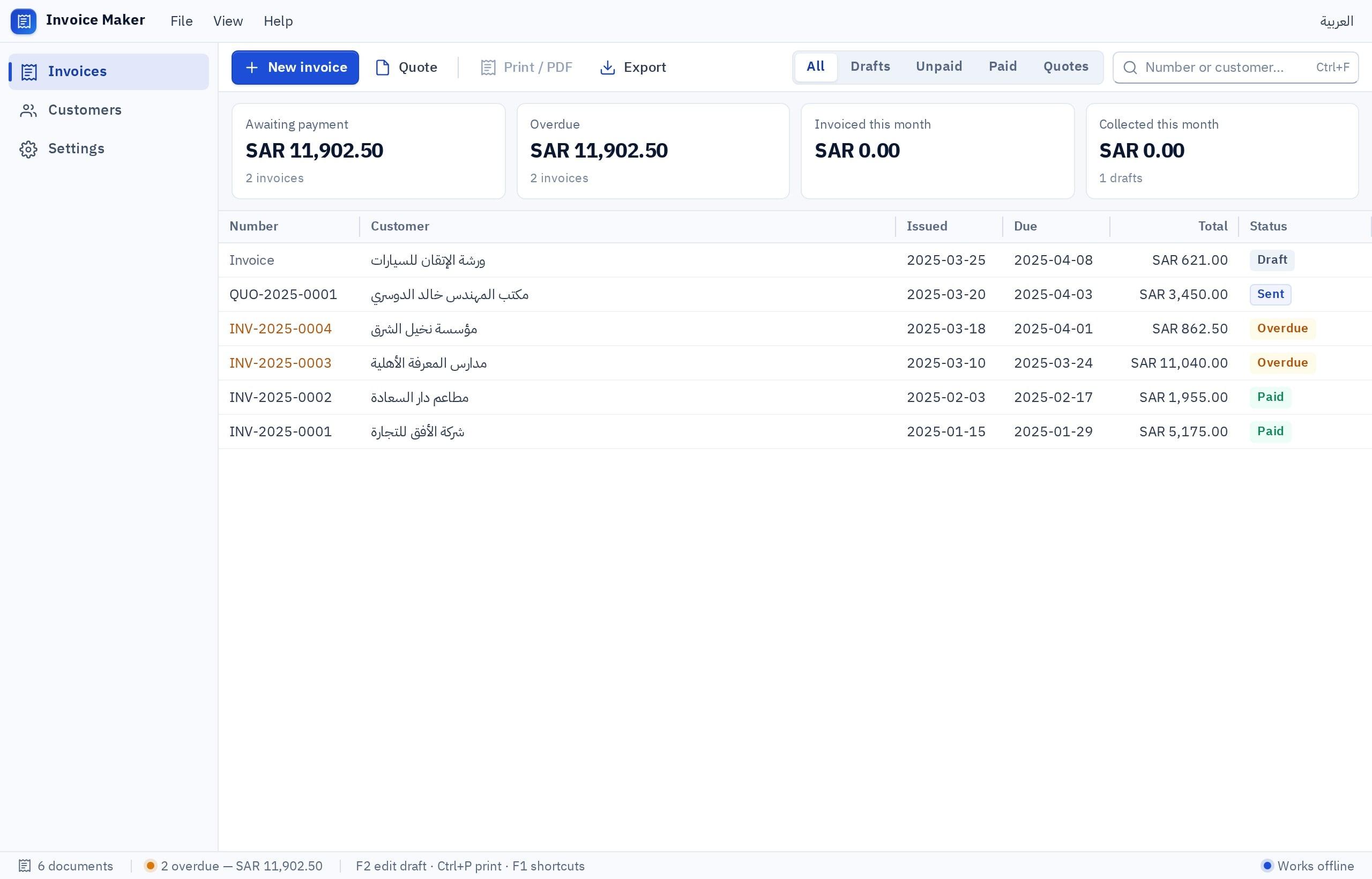
I want a Windows program in Arabic and English for an air-conditioning repair workshop, a simple first version on one PC. Work orders screen: customer, mobile, address, fault type, technician, status (new, in progress, done), amount. A list of orders with search and a status filter. Print the work order on A4. A weekly report with the number of orders and revenue per technician. Export the report to a file. I do not need stock or accounting for now. It works without internet, with backup.
Try it in FanannShould I build, buy or hire?
Pick the one that sounds like you to see the advice.
Buy ready-made software and try it for a month. If it covers most of what you need with no manual workarounds, do not build anything.
Build it by describing it and start with a small version. You pay less, and you change it yourself when the business changes.
Hire a company or an experienced freelancer, but arrive with a requirements document and a working model. That alone lowers the quote and shortens the schedule.
Stay on a well-organized Excel file until it hurts, and build the model for free meanwhile, so you know what to ask for when the time comes.
For the wider picture on app costs in general, see the cost of building an app with AI and the app cost calculator.
The cheapest program is the one used every day. The most expensive is the one paid for in full and left in a drawer.
Key takeaways
- Ask about special cases before the number of screens. Exceptions are what raise the price.
- Data shared between several PCs adds accounts, permissions and hosting. Do not ask for it unless you need it.
- Add up the whole first year: build, changes, support and backups, not just the delivery price.
- Two quotes cannot be compared unless they are based on the same document. Write the requirements first.
- A working model built from a description reveals what you really need before you pay anyone.
Frequently asked questions
How much does a Windows program cost for a small shop?
How much does a developer charge for a cashier program?
What is the cheapest way to make a computer program?
Is ready-made software cheaper than custom software?
Do I pay per PC for a program I built in Fanann?
Can I try before I pay?
Ask your AI assistant about this
Copy this prompt into the AI assistant you use, then add the details of your own case.
I am reading this guide: “What does it cost to build a Windows program? The real cost drivers” https://fanann.com/en/blog/windows-program-cost/ My question: how much does it cost to build a Windows program Use that page as a source and explain the answer step by step for my situation, tell me what to check before I start, and cite the page link.