For a first game, choose 2D in most cases: the whole idea is visible on one screen, controls are simpler, playtesting and tuning are faster, and the game is lighter on phones. Choose 3D from the start if your idea is itself a place to walk through or an object to see from all sides: an obstacle course, a kart race, an island to explore, a product showroom or a room tour. The deciding question is not which looks better but whether the player needs to move in depth.
- 2D or 3D for first game
- should I make a 2D or 3D game
- is 2D easier than 3D game development
- difference between 2D and 3D games
- 2D vs 3D game for beginners
What is the short answer: 2D or 3D for a first game?
2D for most people, 3D for those whose idea is a place. That is the answer; the rest helps you see which group you are in. If you are not sure, pick 2D. You lose nothing, because what you learn comes with you.
Pick the one that sounds like you to see the advice.
2D. These actions read clearly on a flat screen, and adding depth complicates them without adding fun.
3D. Exploration and a sense of place are what the third dimension really offers.
3D. Here the third dimension is the idea itself: the visitor turns the thing around and sees every angle.
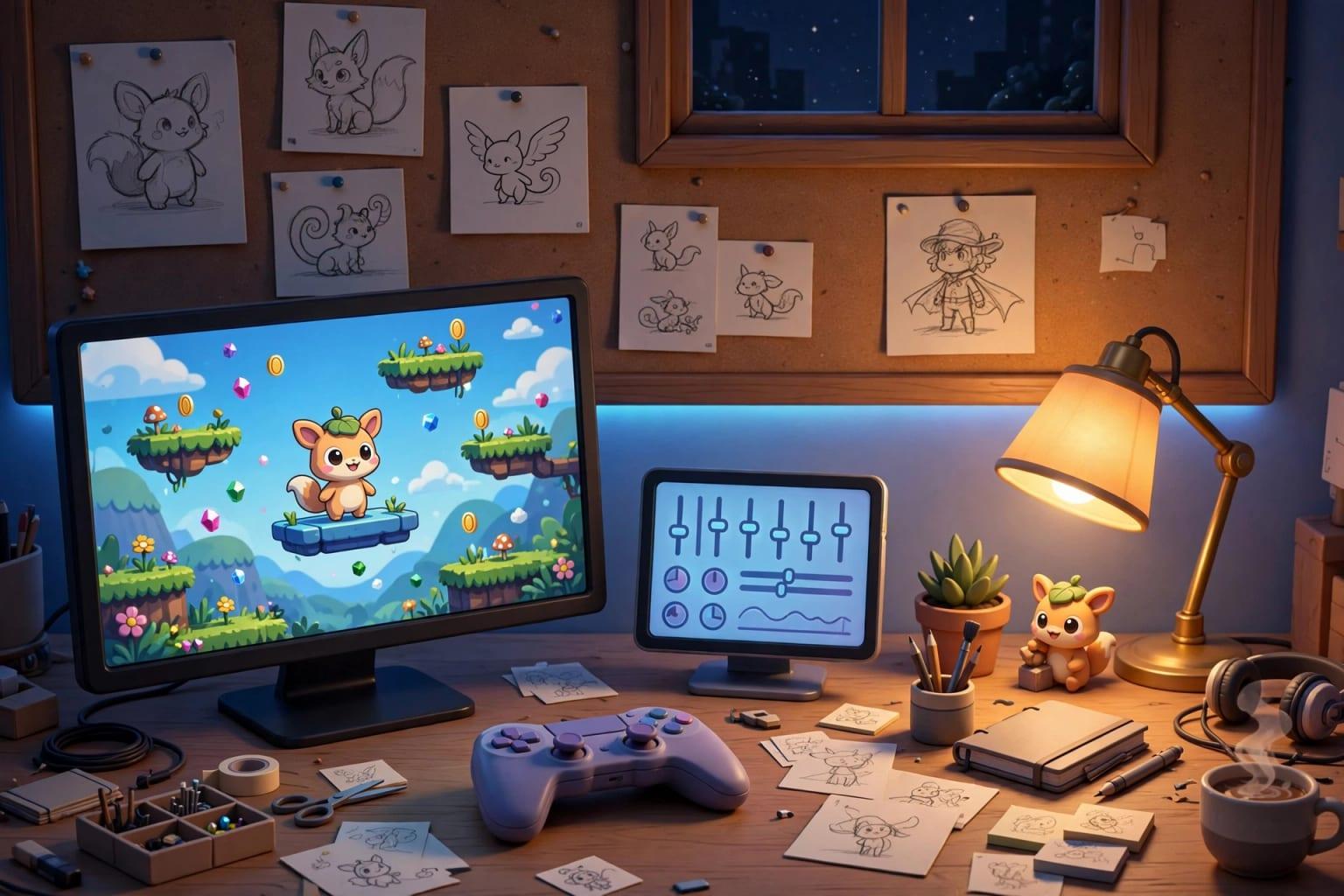
2D, and specifically a platformer or an endless runner. The fastest route to a first finished game.
 Illustration
What is the real difference between making a 2D and a 3D game?
The difference is not quality. Excellent 2D games are made and played every day. The difference is how many decisions you must make before the game becomes fun.
| Aspect | In 2D | In 3D |
|---|---|---|
| What the player sees | The whole screen at once | Part of the world; the rest is behind the camera |
| Camera | Fixed, or follows the hero | A full design decision: behind, own eyes, above, or orbiting |
| Art | Flat pictures | Objects with volume, surface, light and shadow |
| Building a level | Arranging on two axes | Arranging on three, with distances harder to judge by eye |
| Touch controls | Two or three buttons | Moving and looking together: a joystick plus drag |
| Performance | Light on most devices | Depends on the number of objects, lights and details |
| Testing and tuning | You see the problem at once | The problem may be the camera, not the game |
In traditional game engines the gap is wider, because 3D adds modeling and character animation. In describe-it game makers it narrows: worlds are built from simple low-poly shapes, so there is nothing to model. The camera and depth decisions remain yours.
Why do 2D games get finished faster?
 Illustration
- Everything is visible: the player sees danger and goal together. No enemy behind them, no platform whose distance they misjudged.
- The rules are familiar: platformers, runners and matching are genres everyone knows, so nothing needs explaining.
- Tuning is clearer: change jump strength and you see the whole difference in the arc drawn in front of you.
- Phones like it: one or two buttons, short rounds, good performance on many devices.
- Testing is quicker: a thirty-second round exposes the problem. In a 3D world you may walk for a minute to reach the section you want to test.
2D Game Design has eight templates covering the familiar genres: platformer, endless runner, space shooter, maze, match-3, kids quiz, top-down racing and tower defense. If your idea is in one of them, it is a 2D idea.
When is 3D the right choice from the start?
When the third dimension is the idea, not decoration. A simple test: if you drew your game from the side or from above, would it still be the same game? If yes, it is 2D. If something essential is lost, it is 3D.
 Illustration
| Idea | Why 3D | Closest template |
|---|---|---|
| An obstacle course you balance across | The sense of height and falling | Obstacle course |
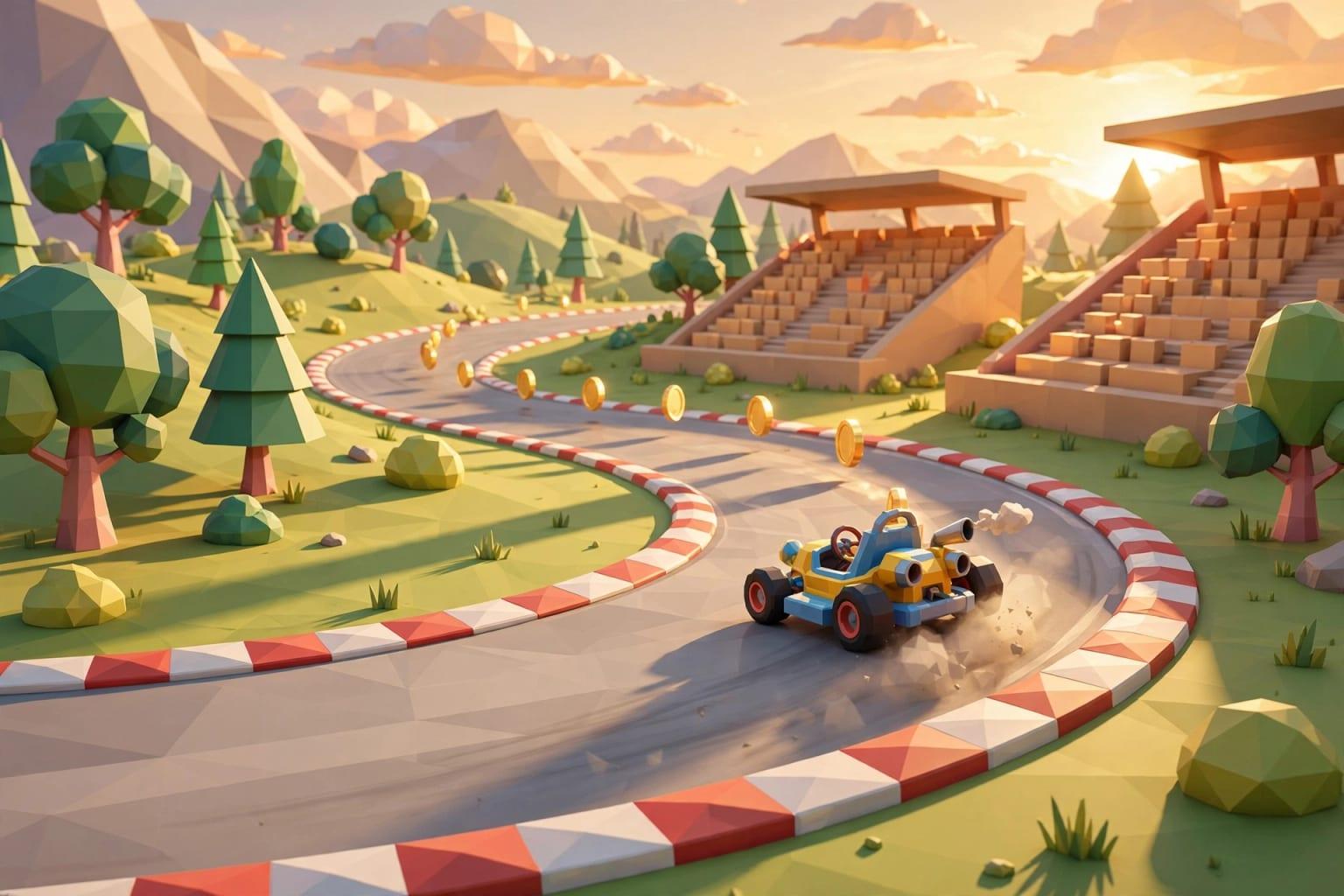
| A race driven from behind the vehicle | The sense of speed and cornering | Kart racer |
| A calm place to wander | Discovery needs a world around you | Exploration island |
| A puzzle solved by standing in places | The place is part of the puzzle | Puzzle adventure |
| A product shown from all sides | The visitor turns it themselves | Product showroom |
| Convincing a client of a room design | They see the space as if inside it | Room design |
| Showing a new hire a warehouse | They walk the aisles before visiting | Warehouse tour |
Notice that half this list is not games in the strict sense. That is one of the strongest reasons to choose 3D: when the goal is for someone to see a place or a product. More in a 3D showroom for your products and 3D room and property tours.
- Style
- Light and stylized, not realistic
- Players
- Single-player, no multiplayer
- Size
- A small world, not a huge open one
- Devices
- A recent browser; a lighter picture on weaker phones
How do I tell where my idea falls?
Answer four questions with yes or no. Each yes leans you toward 3D.
- Zero or one: 2D, no hesitation.
- Two: try 2D first. If something feels missing, move.
- Three or four: 3D, starting from the closest template.
Does what I learn in one help in the other?
Yes, more than you would expect. What makes a game good is the same in both; the tools you express it with differ.
- Shrinking the idea until it can be finished
- The core loop: action, danger, reward
- Tuning numbers: speed, jump, gravity, lives
- Teach, then test, then mix
- Playtesting in silence
- Choosing the view and camera
- Judging distances in depth
- Lighting and time of day
- Watching performance and the world budget
- Controls for moving and looking together
That is why many advise starting in 2D even if your dream is 3D: you learn half the list without the other half in the way. The same skills are needed if you one day move to a game engine, as ways to make a game, compared explains.
How do I try both in one afternoon?
The best thing about making by description is that the decision is no longer theoretical. Write the same idea twice and play both results. Half an hour each is enough to know which one is your game.
Make a 2D platformer: a small explorer jumps between rocks floating in the sky, collects ten crystals, avoids birds and reaches a glowing gate. Three levels, three lives and a checkpoint in the middle of each level. Touch buttons on phones.
Try it in FanannBuild a 3D obstacle course: rocky islands floating in the sky at sunset. The player is a character I see from behind who jumps between the islands and two moving platforms, collects ten crystals and reaches a glowing gate that is the finish line. Two checkpoints and three lives.
Try it in Fanann- 1Play each version for five minutes
No changes. Notice which one made you smile more.
- 2Try one change in each
In 2D, drag the jump slider. In 3D, move a platform by hand and change the time of day.
- 3Open both on your phone
Which is more comfortable under your thumb? Which runs more smoothly on your device?
- 4Pick one and finish it
Do not finish both. A finished game matters more than a perfect decision.
Build steps for each route: make a 2D game with AI and make a 3D game with AI.
What are the common mistakes in this decision?
Most people who regret their choice made one of these mistakes. They are easier to avoid than to fix.
- Choosing the look before the idea: deciding I want a 3D game and then hunting for something to do in it. Start with what the player does; the dimension follows.
- Moving a 2D game into 3D for no reason: a matching game or a quiz gains nothing from depth and loses its clarity.
- A big, empty world: in 3D, space is tempting. A small world full of things to do beats a wide one where the player walks a minute with nothing happening.
- Testing on a computer only: many of your players are on phones. What runs smoothly for you may stutter for them, especially in 3D.
- Deliberating too long: a week of comparing teaches less than an hour of playing. Try, then decide.
Add the third dimension when the idea needs it, not when your pride does.
Key takeaways
- 2D is the safe choice for a first game: fewer decisions, faster testing, lighter on devices.
- 3D is not only harder but different: camera, depth and lighting are added on top of everything in 2D.
- Choose 3D when the idea is a place or an object, not because you want the game to look professional.
- Design skills transfer between the two: scope, the core loop, feel and playtesting.
- By describing it, you can try the idea both ways in one afternoon and decide with your hands.
Frequently asked questions
Should I start with a 2D or a 3D game?
Is making a 3D game harder than 2D?
Are 2D games still popular?
Can I convert my game from 2D to 3D later?
Which is lighter on phones?
Can I make a 3D game without coding at all?
Ask your AI assistant about this
Copy this prompt into the AI assistant you use, then add the details of your own case.
I am reading this guide: “2D or 3D: which should your first game be?” https://fanann.com/en/blog/2d-or-3d-first-game/ My question: 2D or 3D for first game Use that page as a source and explain the answer step by step for my situation, tell me what to check before I start, and cite the page link.